AIImpish
NVIDIA released Nemotron 3.5 Transcribe on October 28, 2026, an open-weight speech model that handles transcription, translation, speaker labels, and audio questions in one checkpoint. Alongside it, NVIDIA published Granary v2, the open speech dataset and pipeline used in its training.
Coffee summary
- FACT: Transcribes 40 languages, translates 31 of them to or from English, and attributes speakers in 13.
- FACT: Handles recordings up to one hour and labels up to eight speakers, with word-level timestamps on request.
- FACT: It is a mixture-of-experts model with about 4.3B active parameters, released under the OpenMDW-1.1 license on Hugging Face, NGC, and build.nvidia.com.
- CLAIM: NVIDIA says it is the best open-weights model on the Open ASR Leaderboards, with a mean word error rate of 4.71% on the English board and 4.62% on the multilingual board.
- OPINION: If you run meetings, interviews, or podcasts in several languages, this is worth a test, especially if you want audio to stay on your own hardware.
One model, many kinds of transcript
NVIDIA's key idea is that there is no single correct transcript. A lawyer may want every "uh" kept, while a blog post wants clean sentences, and a finance team wants "€25" instead of "twenty-five euros." With Transcribe, you choose the style with a plain-language instruction for each request, without retraining.
It can also take a list of expected names or terms. NVIDIA says this contextual mode reduces named-entity errors six-fold on ContextASR-Bench, which matters for product names, medical words, and people's names.
Speaker labels that hold up in real meetings
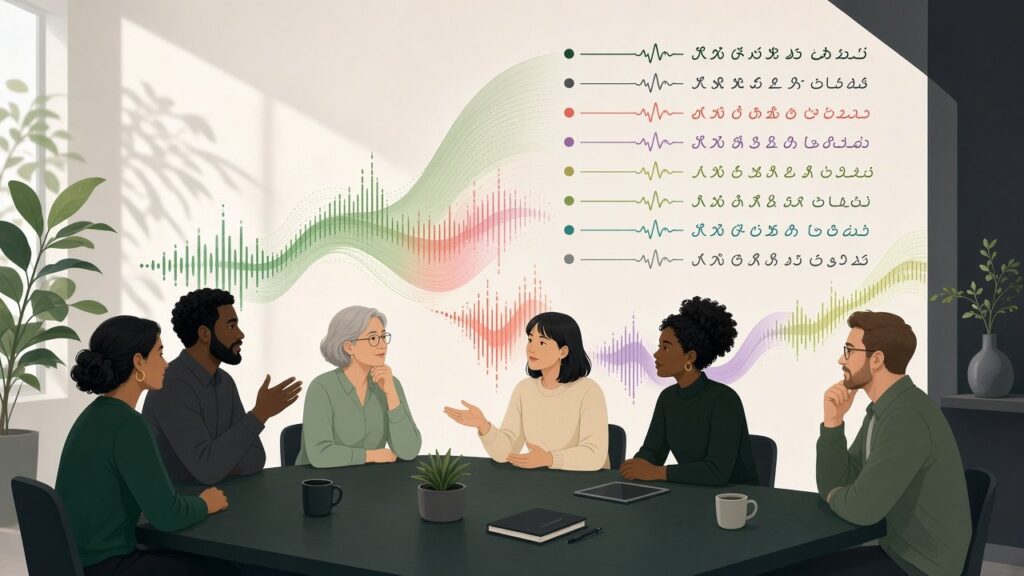
Overlapping speakers are where many transcription tools fall apart. NVIDIA says Transcribe sets a new state of the art on speaker-attributed transcription for overlapping speech, from one-minute clips to full meetings, and that it is the first model of its kind to beat specialized multi-step systems on this task. CLAIM: these are NVIDIA's own results; check them against your own recordings.
Speed and where it runs
NVIDIA reports that the NVFP4 version with its DFlash2 draft model can transcribe up to 2,238 seconds of audio per second on a single RTX PRO 6000 Blackwell GPU. Checkpoints come in BF16, FP8, NVFP4, and GGUF formats, and NVIDIA's Hugging Face post says more quantized versions are coming for local devices like DGX Spark and Jetson AGX Thor.
Granary v2: the data behind it
Granary v2's public manifest covers 463,062 hours of speech across 48 languages, up from 25 languages in the first version. NVIDIA notes these figures describe the dataset release, not the full training mix. The curation pipeline and training recipes are open source, which helps teams adapt the model to their own accents and vocabulary.
What this means for you
- Creators: cleaner multilingual captions and show notes, with speaker names for interviews.
- Small businesses: meeting notes and call summaries without sending audio to a third-party cloud, if you can host it.
- Developers: one model instead of a chain of separate transcription, diarization, and translation tools.
What we still don't know
- How it performs on noisy phone audio in less common languages.
- Real hosting cost for small teams without data-center GPUs.
Bottom line
Nemotron 3.5 Transcribe brings strong, promptable transcription into the open. Test it on your own recordings, compare the speaker labels with your current tool, and keep a human check on anything that becomes a record.
*Sources: NVIDIA Research, Nemotron 3.5 Transcribe; Hugging Face blog; Model card; Granary v2.*